
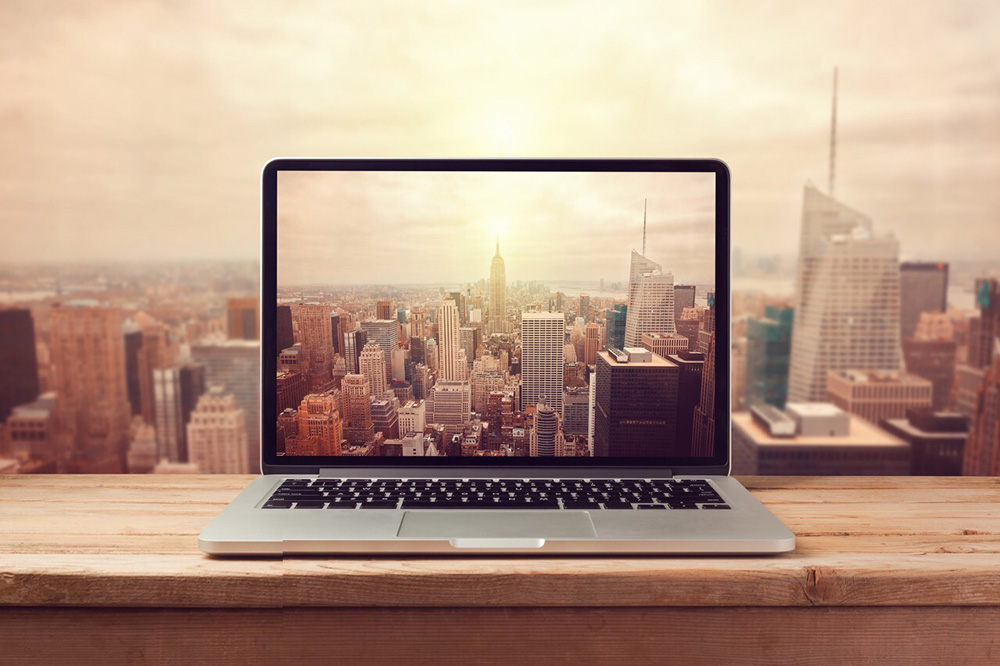
From its very first appearance right up to today, the PC, or personal computer, has been constantly evolving. Both its components and its features have undergone considerable changes.
More powerful and smarter than ever, one question remains: what will the laptop of the future look like?
How have laptops evolved over time?
Computers started out with bulky CRT screens and a tower that also took up a lot of space. Laptops were then invented to make them easier to move around.
Laptop components have become slimmer over the years, giving rise to the models today’s users prefer. The laptop now has a thin, lightweight, compact screen. It no longer needs a separate tower and the keyboard is already built in.
In recent years, touchscreens have also appeared. The laptop can now be controlled directly without using the keyboard and mouse.
These devices are available in ever smaller sizes and weigh less and less. Some laptops are under 8 inches and weigh no more than 2 kg.
What changes can we expect from the computer of the future?
The developments planned for future computers are being designed to meet users’ needs. Easier to use, more automation, more intelligence… researchers are continuing to explore what can be improved.
The various technologies shown in science‑fiction could also inspire manufacturers. But whatever changes are made, the PC must always remain practical and high‑performing. It is, after all, mainly used for professional purposes.
Can we dream of a laptop with a very large screen? Voice and facial recognition? Different aspects of the laptop could be transformed.
More advanced design
To make it easier to carry, the computer has become thinner and thinner. After touchscreen and foldable laptops, further evolution in terms of design is not obvious. Yet companies’ creativity and technology watch should not be underestimated.
To optimise the workspace, screen bezels could become even thinner. A separate device acting as an image enlarger could also be added to the laptop of the future.
Simplified data synchronisation
Synchronising data is still time‑consuming for users who work with several devices. Updating the information stored on different devices, tablets and laptops may not always be done systematically.
The creation of a mini tower could therefore be considered. This would act as a mini PC connected to the keyboard and make data synchronisation easier.
Connectivity evolution
Just like tablets and smartphones, the laptop of the future could benefit from better connectivity. Network activation could be possible whether the laptop is on or off. Users could, for instance, receive an email notification even when their computer is stored in a bag.
An integrated SIM card could make network access available. Although this is still a difficult project to bring to life, ongoing research could lead to such an innovation. Engineers at major brands such as Dell, HP or Lenovo may already be working on this project.
Changing interfaces
Bear in mind that, 20 years ago, the devices we use today were considered unlikely. So we can imagine various improvements to current laptop interfaces.
New forms of interaction could emerge between the user and their laptop. Besides the keyboard and mouse, other means of communication, such as voice control, could be further developed.
